
State-of-the-Art Review and Future Directions in Artificial Intelligence-Based Detection of Brain Tumors Using MRI Datasets

- 2025-12-21 (2)
- 2025-12-01 (1)
Versions
- 2025-12-21 (2)
- 2025-12-01 (1)
Downloads
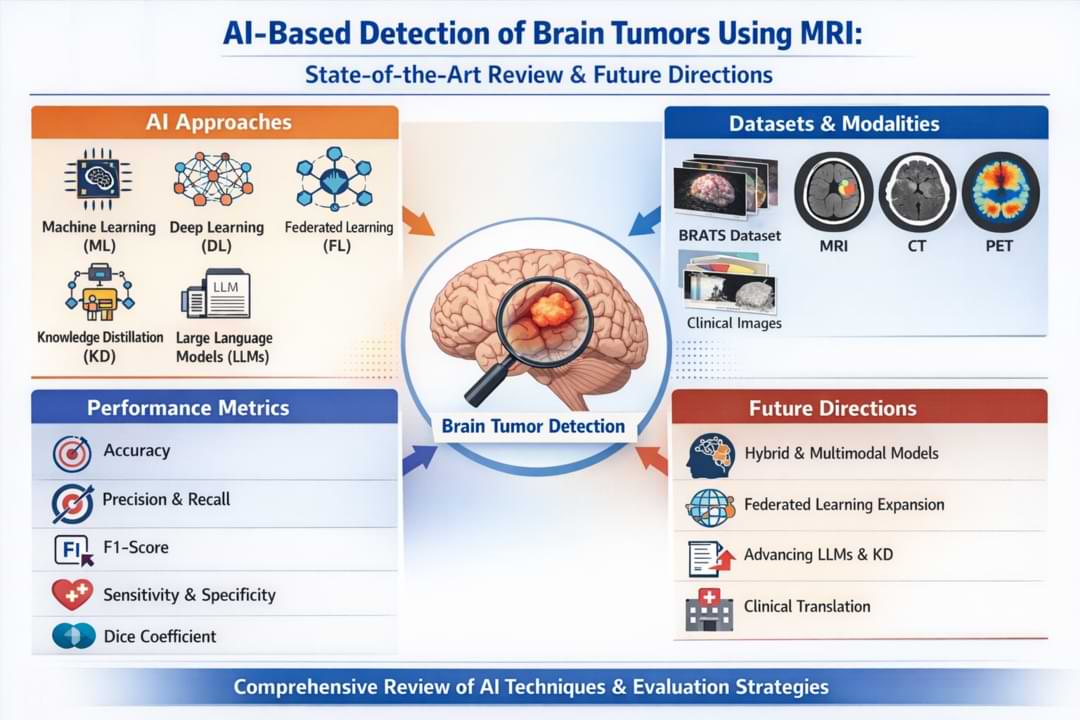
Brain tumors are increasingly common, and accurate diagnosis remains a challenge for clinicians. Magnetic Resonance Imaging (MRI) is a very common and efficient approach for detecting tumors, for this reason researchers apply several AI approaches for making the result efficient. Artificial intelligence (AI) offers a powerful solution to enhance detection accuracy and reliability. This study explores the overall AI methods for brain tumor detection using MRI brain tumor datasets. It highlights widely applied algorithms, including Machine Learning (ML), Deep Learning (DL), Federated Learning (FL), Knowledge Distillation (KD), and Large Language Models (LLMs). In addition to algorithms, this study reviews dataset sources such as BRATS, Kaggle, and real-world clinical data, along with their classification schemes (e.g., glioma, meningioma, pituitary, yes/no tumor). Imaging modalities beyond MRI, including CT and PET, are briefly noted for context. The paper further examines performance evaluation strategies, focusing on metrics such as accuracy, precision, recall, F1-score, sensitivity, specificity, and Dice coefficients. The innovation of this work lies in its integrated analysis of diverse AI approaches, dataset variations, and evaluation metrics, which together provide a comprehensive perspective missing in prior reviews. By comparing strengths and limitations across studies, the review identifies promising techniques and critical gaps in current research. Finally, the paper outlines future directions, including hybrid and multimodal AI frameworks, broader application of FL, KD, and LLMs. These insights aim to guide researchers, practitioners, and newcomers in advancing AI-based brain tumor diagnosis.
Downloads

This work is licensed under a Creative Commons Attribution-ShareAlike 4.0 International License.