Focus & Scope Author Guidelines Review Process Manuscript Template Publication Ethics Publication Frequency Open Access Policy Plagiarism Policy Editorial Board Processing Charge
Author Guidelines
Thank you for considering submitting your work to the Journal of Applied Technology and Innovation (JATI). To ensure a smooth and efficient review process, please follow the guidelines outlined below.
- General Notes to Authors
The JATI peer-review process is single-blinded; reviewers know the authors of the manuscript, but authors do not know the reviewers’ identities. Every manuscript submitted to JATI undergoes the following editorial workflow during the review process.
Editorial Workflow
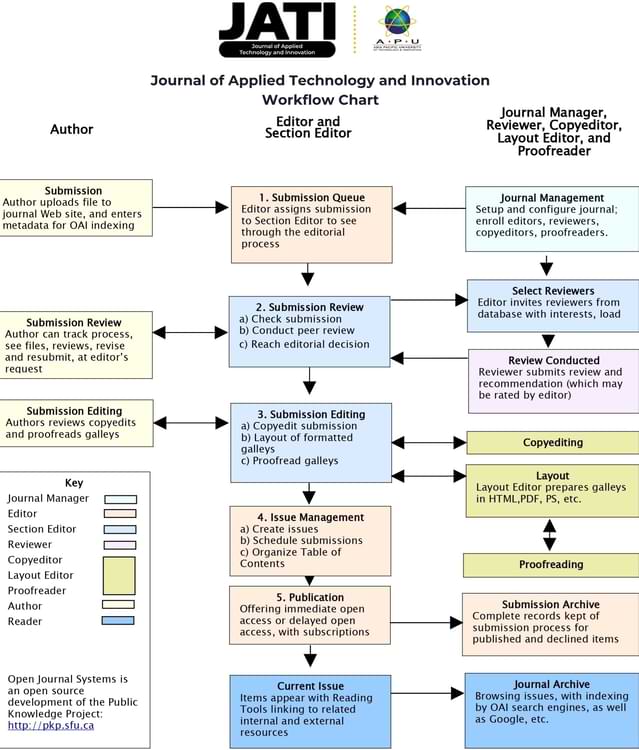
- A manuscript is submitted to the journal by the corresponding author.
- The Editor-in-Chief reviews the manuscript to determine its suitability for review and assigns it to an Associate Editor based on subject area.
- The Associate Editor oversees the review process and assigns the manuscript to at least two qualified external reviewers, ensuring no conflict of interest exists.
- Reviewers evaluate the manuscript in accordance with the journal’s publication standards and ethical requirements.
- The Associate Editor reviews the reports and provides a recommendation to the Editor-in-Chief.
- Based on reviewers’ reports and the Associate Editor’s recommendation, the Editor-in-Chief makes one of the following decisions:
- Publish unchanged:The manuscript is accepted for publication.
- Minor revisions:Authors are requested to make revisions within a specified time period and submit a detailed response to reviewers’ comments.
- Major revisions:The revised manuscript may be reviewed again by the Associate Editor and/or the original reviewers.
- Reject:Rejection is typically due to methodological or scientific concerns; reasons for rejection are communicated to the authors.
- Only the Editor-in-Chief has the authority to approve a manuscript for publication. Associate Editors recommend acceptance to the Editor-in-Chief.
- Manuscript Preparation
- Format: Manuscripts should be prepared in Microsoft Word (.doc or .docx) format. LaTeX submissions are also acceptable.
- Length: There is no strict page limit; however, manuscripts should be concise and well-structured between 4000 and 8000 words.
- Title and Authorship Information: Include the paper title, full author names, complete institutional affiliations, and valid email addresses for all authors.
- Abstract: Provide a self-contained abstract not exceeding 250 words. It should summarize the purpose, methodology, major findings, and conclusions. No citations should appear in the abstract.
- Keywords: List a minimum of three and a maximum of six keywords separated by commas and one SDG keyword as applicable.
- Structure:
Introduction: Present the background, objectives, and significance of the study clearly and succinctly. Explain the context of the problem, the motivation for the research, and the intended contribution to the field. - Literature Review: Provide a concise and critical overview of relevant scholarly work. Summarize existing theories, models, or empirical findings related to your topic. Highlight gaps, limitations, or inconsistencies in previous research that justify the need for your study.
- Materials and Methods: Provide sufficient detail to allow replication of the study. Describe materials, procedures, instruments, data collection methods, and analytical techniques. Subsections may be used for clarity when multiple methods are described.
- Results and Discussion: Present and interpret the research findings in a clear and logical manner. Discuss how your results align or contrast with previous studies. Subheadings may be used as appropriate to structure the discussion.
- Conclusions: Summarize the main outcomes, significance, and relevance of the work. Emphasize the implications, limitations, and possible directions for future research.
- Declarations:Acknowledgment, Data Availability Statement, Conflict of Interest, Ethical Approval (if applicable).
- References: All references must be complete and accurate. The APA 7th Editionreferencing style is required for JATI publications. A guide to APA referencing is available at https://library.apiit.edu.my/apa-referencing.
- Figures and Tables
- Figures: All figures should be cited consecutively in the text. Acceptable formats include vector (AI, EPS, WMF, PowerPoint) and bitmap (TIFF, GIF, JPEG) with a minimum resolution of 300 dpi. Each figure should have a descriptive caption.
- Tables: Tables should be cited consecutively, numbered, and include descriptive titles. Units must be provided in column headings where applicable.
- Units of Measurement: Use the International System of Units (SI) consistently throughout the manuscript.
- Ethical Considerations
- Originality:Manuscripts must be original, unpublished, and not under consideration elsewhere.
- Plagiarism:All submissions are checked for plagiarism with iThenticate. Proper acknowledgment of others’ work is mandatory.
- Conflicts of Interest:Authors must disclose any potential conflicts of interest.
- Ethics Approvals:Studies involving human or animal subjects must provide ethical clearance and approval numbers, where applicable.
- Submission Process
- Online Submission:Manuscripts must be submitted through the journal’s online submission system on the OJS platform.
- Authorship:Submissions must be made by one of the listed authors, who will act as the corresponding author and remain responsible throughout the review and publication process.
- File Type:Only Word (.doc, .docx) files are accepted.
- Sample Paper:Authors may download the JATI manuscript template for guidance.
- Review and Revision Process
- All manuscripts undergo single-blind peer review.
- Authors must address reviewers’ comments point-by-point when revising.
- Revised manuscripts should be submitted within the specified time frame.
- The Editor-in-Chief makes the final publication decision.
- Copyright and Licensing
- Copyright:Authors retain full copyright of their work; JATI holds the rights of first publication.
- License:All articles are published under the Creative Commons Attribution 4.0 International License (CC BY 4.0), allowing unrestricted use, distribution, and reproduction, provided the original work is properly cited.
- Open Access Policy
JATI is an open access journal. All articles are freely available online without subscription or access charges, in accordance with the Budapest Open Access Initiative (BOAI). Users may read, download, copy, distribute, print, or link to the full texts of articles without prior permission, provided proper attribution is given.
- Contact Information
For inquiries related to submissions, guidelines, or technical assistance, please contact:
Editorial Office
Journal of Applied Technology and Innovation (JATI)
Asia Pacific University of Technology & Innovation (APU)
Strategic Research Institute (SRI)
Email: jati.editor@apu.edu.my